TikTok AI Music Policy 2026
TikTok does not ban AI music — it labels it, and the label is applied by machine whether or not you declare anything. But the labelling system TikTok built reads video, not audio, which means an AI track and an AI video hit completely different rulebooks on the same platform. We mapped both doors, the gates behind them, and where the enforcement actually bites.

- TikTok allows AI music. There is no ban and no upload classifier for sounds — the policy is disclosure and labelling, enforced through a penalty ladder that starts by removing your video from the For You feed.
- TikTok was the first video platform to implement C2PA Content Credentials, auto-labelling AI content made elsewhere from 9 May 2024. It has labelled over 1.3 billion AI videos, and joined the C2PA steering committee on 28 July 2026.
- The gap that matters to musicians: that auto-label launched on images and video, with audio-only content promised “soon” — and we can find no evidence a general audio-only auto-label has shipped since. Your track is not read the way your video is.
- The real gate is upstream. TikTok's sound library is reached through a distributor, and raw AI exports fail DistroKid's ~0.78 classifier at 50/50 in our corpus before TikTok ever sees the file.
- SoundOn, TikTok's own distributor, added ACRCloud Derivative Works Detection on 2 April 2026 — photo-ID verification on upload and fingerprint matching that catches pitch- and speed-shifted copies before distribution.
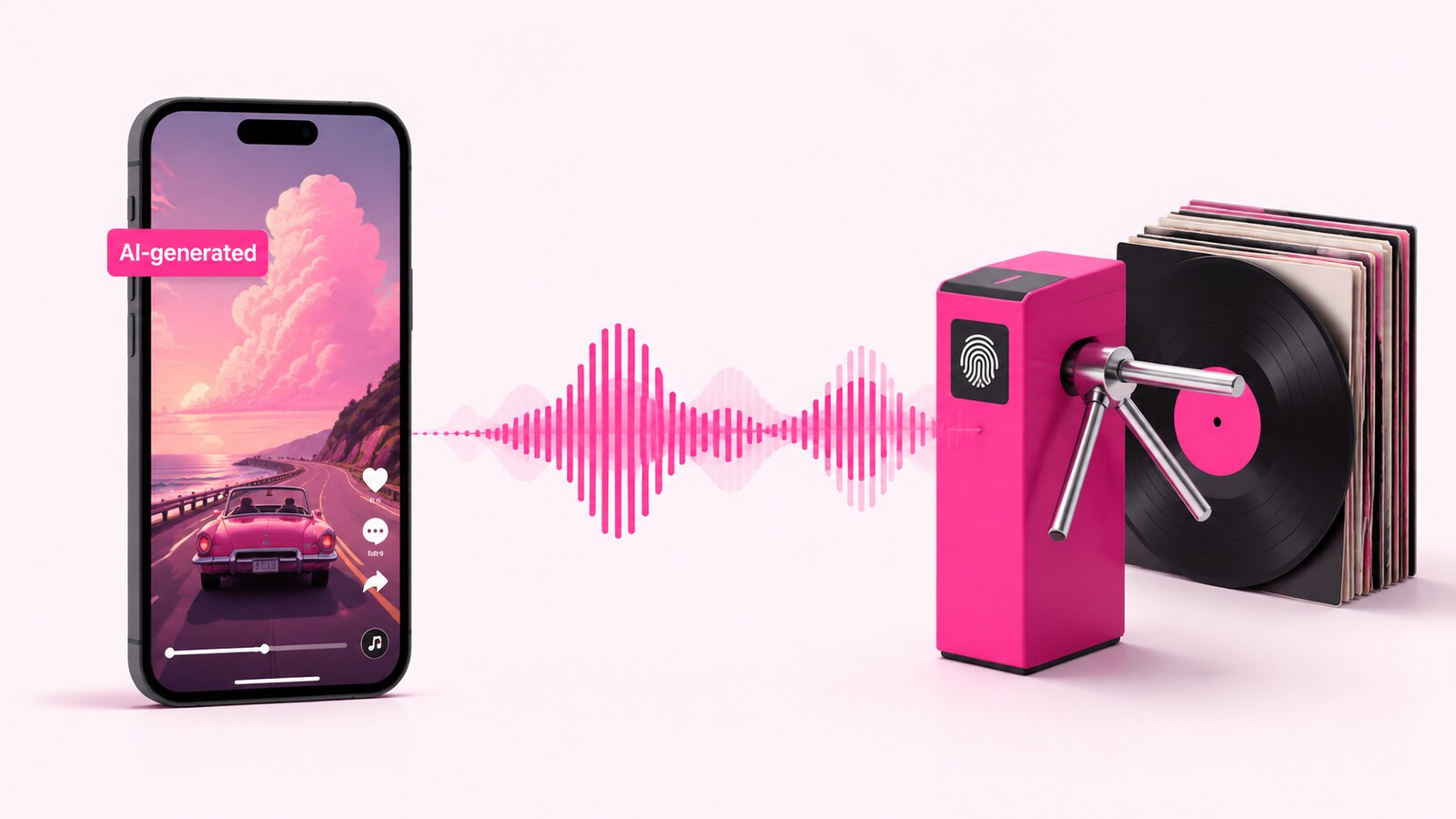
The TikTok AI music policy is the most widely misread rulebook in AI music, and the misreading costs people reach rather than getting them banned. TikTok does not prohibit AI-generated music. What it does is label AI content by machine, whether or not you declared anything — and then quietly withhold the For You feed from work that should have carried a label and did not. Losing the feed is not a strike you can appeal into oblivion; it is a video that stays up and reaches nobody.
Here is the structural fact almost every guide misses, and it is worth getting straight before anything else. TikTok's labelling system reads video. It does not, as far as we can establish, read your audio. The auto-labelling capability launched on images and video on 9 May 2024; audio-only content was described as coming soon in the same announcement, and two years on we can find no evidence a general audio-only auto-label has shipped. So an AI song and an AI video hit completely different rulebooks on the same platform, on the same upload.
That leaves the real screening somewhere most creators never look: upstream, at the distributor whose classifier decides whether your track reaches TikTok's sound library at all. We mapped both doors, both sets of gates, and where the enforcement actually bites.
What the policy actually says
TikTok's position is disclosure, not prohibition. The 2026 rules require visible labelling on AI-generated content that depicts realistic people, places or events — including AI-generated speech — and treat the AIGC label as a transparency notice rather than a penalty. Music made with Suno, Udio or ElevenLabs is welcome on the platform in a way it simply is not on CD Baby, which rejects wholly AI-generated releases as a matter of written policy.
Three obligations sit underneath that permission, and only the first is about AI at all:
You must hold the rights. Standard, and unchanged by AI. It means generating under a licence that grants commercial release rights — Suno Pro or Premier, Udio's paid tiers — rather than exporting from a free account and hoping.
You must not impersonate. TikTok's music terms prohibit uploading AI music videos whose vocals were created from a person's voice with the intent to create a false impression that their real voice was used. This is the hard limit, and it is hard on purpose.
You must label realistic synthetic media. Expected of you, and applied by TikTok when its systems detect AI regardless.
The interesting part is what happens when obligation three meets a technology stack that was built to read pictures.
Two doors, two rulebooks
Your AI music can reach TikTok two entirely different ways, and almost nothing about the two routes is the same. This is the distinction that makes most TikTok AI-music advice contradictory — half of it is describing one door, half the other.
| Route | Who screens the file | What gets checked | AI label on the sound? | Time to live |
|---|---|---|---|---|
| Distributor → TikTok sound library | Your distributor, then TikTok/SoundOn ingest | AI classifier, rights, fingerprint match | No sound-level AI label today | 1–4 weeks |
| In-app "original sound" | TikTok upload moderation only | C2PA credentials, video classifiers, Community Guidelines | Video may carry the AIGC label | Minutes |

The library route is the one that makes you a catalogued artist — a sound page, a searchable track, royalties, and eligibility for the Commercial Music Library that businesses can license from. It is also the route with a real classifier standing in front of it, and that classifier belongs to your distributor, not to TikTok.
The original-sound route bypasses all of that. Post the video, the audio becomes a sound other people can use, and nothing screened the file for AI artifacts on the way in. It is fast, it is free, and it earns you nothing beyond reach.
Most serious creators end up doing both, which means clearing both sets of rules. Bridge that gap in the wrong order — post first, distribute later — and you can find your own original sound competing with your distributed release for the same audience.
How TikTok detects AI, and where it stops
TikTok was the first video-sharing platform to implement C2PA Content Credentials, the provenance standard co-founded by Adobe and Microsoft. Credentials are metadata attached at generation time, naming the model that made the file, and TikTok reads them on upload to recognise and label AI content instantly — no classifier guesswork required. It upgraded from general member to a seat on the C2PA steering committee on 28 July 2026, so this is a commitment that is deepening rather than drifting.

The scale is real: over 1.3 billion AI videos labelled, and more than 37 million creators had used TikTok's own labelling tool within months of launch. TikTok also attaches credentials to content made on the platform so they survive download and re-upload elsewhere.

Now the part that matters to musicians:
| Content type | C2PA read on upload | Auto-label applied | Basis |
|---|---|---|---|
| Video | Yes | Yes, since 9 May 2024 | TikTok Newsroom |
| Image / slideshow | Yes | Yes, since 9 May 2024 | TikTok Newsroom |
| Audio-only upload | Announced | No general capability found | "Coming soon", May 2024 |
| Distributed sound | Screened upstream instead | No sound-level label | Our testing |

Read that table honestly rather than opportunistically. It does not say TikTok cannot tell your song is synthetic — TikTok's audio analysis is demonstrably capable of comparing spectral patterns to detect cloned voices, which is a harder problem than detecting a watermark. It says the automatic labelling pipeline that fires on 1.3 billion videos is pointed at pictures, and that TikTok said two years ago it intends to point it at audio too.
Anyone building a release strategy on the assumption that audio stays unread is building on a stated roadmap item. The artifacts in a raw generator export — SynthID, C2PA credentials, spectral fingerprints, generation metadata — do not decay while you wait. A file that is clean before it ships is clean whenever the scanner arrives; a file that is not becomes a back-catalogue problem the day it does.
The SoundOn gate
SoundOn is TikTok's own distribution service, and it is the one route that puts music into the sound library and the Commercial Music Library without a third party in the middle. It is also, as of 2026, the most aggressively policed door on the platform.
On 2 April 2026 SoundOn deployed ACRCloud's Derivative Works Detection. The system uses audio fingerprinting to identify copyrighted recordings uploaded without authorisation, explicitly including works significantly altered through speed or pitch shifting — the classic laundering trick. Uploaders verify identity with photo ID, and anything flagged escalates to human review before it can be distributed. SoundOn's EMEA head called it a "best-in-class technology solution"; the context is the protections TikTok committed to in its Universal Music Group licensing deal, which included commitments against AI-made and AI-manipulated music affecting UMG's roster.

Be precise about what that system targets, because the internet has been sloppy about it. Derivative works detection is rights enforcement, not AI detection. It asks whether your upload is somebody else's recording wearing a disguise. A wholly original AI composition is not what it hunts. An AI cover of a chart record, pitched up 4% to defeat fingerprinting, is exactly what it hunts — and it will find it.
The gate that actually stops people
Here is where the TikTok question stops being about TikTok. If you are taking the library route through a conventional distributor, your file meets that distributor's AI classifier long before TikTok's ingest sees it, and those classifiers are the strictest screening layer in the entire chain.
| Distributor | AI classifier threshold | Raw AI exports rejected (50-track corpus) | Reaches TikTok library |
|---|---|---|---|
| DistroKid | ~0.78 | 50 / 50 | Yes, via CML opt-in |
| TuneCore | ~0.82 | 47 / 50 | Yes |
| CD Baby | ~0.85 | 42 / 50 | Policy rejects fully-AI regardless |
| SoundOn | Not disclosed | — | Direct |

Fifty out of fifty. Every raw export from Suno, Udio and Stable Audio in our corpus was rejected by DistroKid's classifier on ingest. Not flagged for review — rejected. TikTok's permissive policy is irrelevant to a track that never cleared the distributor.
What those classifiers read is the artifact layer: Google's SynthID watermark woven into the signal, C2PA credentials in the file's provenance data, spectral fingerprints unique to each generator, machine-perfect timing grids, and generation metadata most producers never open. All of it inaudible by design, which is precisely why the DAW-based remedies people reach for cannot touch it — you cannot hand-edit what your spectrogram will not show you. We ranked what actually removes those layers and what merely degrades your audio while leaving them intact.
For the arithmetic on which release routes are worth the effort once a track is clean, EraseAI runs the per-hour numbers on each route.
What gets labelled, muted, or buried
Three different enforcement outcomes get conflated constantly, and they have three different causes.
Labelled. The AIGC notice on your video. Applied by you or by TikTok's detection, driven by C2PA credentials and visual classifiers. Not a penalty — labelled content performs normally.
Muted. Almost always a rights problem, not an AI problem. TikTok's audio matching catches unlicensed commercial recordings the same way YouTube's Content ID does. Your own AI track will not be muted for being AI.
Buried. The one that actually costs you. Realistic AI content that should have been disclosed and was not becomes ineligible for the For You feed, with a short appeal window. The video is live, the metrics say nothing is wrong, and the distribution simply never arrives.
Buried is the default failure mode on TikTok, and it is invisible from the creator side. That asymmetry is the whole argument for labelling voluntarily: the label costs you nothing measurable, and its absence can cost you everything the platform was for.

Voice clones: the line that does not move
Every other rule on this page is procedural — clear a gate, tick a box, clean a file. This one is categorical.
TikTok prohibits AI music videos using a real person's voice to create the false impression that they performed it. The UMG agreement layers contractual protection for that roster on top. And the enforcement here does not start at the gentle end of the ladder: impersonation goes to removal and account action, not to a missing-label notice.
It is worth saying plainly, because the artifact-removal industry has an incentive not to: cleaning a file's watermarks does not make a voice clone permissible. Those systems address whether a file looks machine-generated. The objection to a voice clone is about whose voice it is — a rights question that no amount of signal processing answers. Voice cloning built on your own voice, or a licensed one, is ordinary production. Built on someone else's, it is the fastest route to losing an account on this platform.
Releasing AI music on TikTok without losing reach
The workflow that survives contact with all of the above, in order:
Generate under a commercial licence. Suno Pro or Premier, Udio's paid tiers. Export lossless where your tier offers it — every lossy round trip before processing costs quality you never get back.
Clean the artifact layer before the first upload, not after the first rejection. This clears the distributor gate that stops 50 out of 50 raw exports, and it future-proofs the file against the audio labelling TikTok has already said is coming.
Pick your door deliberately. Library route for a catalogued, monetisable, licensable track; original sound for speed. If you want both, distribute first and post second.
Label your realistic AI content. It costs nothing and it is the difference between a video that reaches people and one that quietly does not.
Never clone a voice you do not have rights to. No technical step makes this safe, and nothing else on this list matters if you get it wrong.
Do those five and TikTok is genuinely one of the friendliest major platforms for AI music in 2026 — far more permissive than Spotify's policy layer, and structurally similar to SoundCloud's open door with a much larger audience behind it. The platform is not trying to keep you out. The distributor in front of it very much is.
Sources: TikTok Newsroom on Content Credentials, the C2PA standard, and Music Business Worldwide on the SoundOn/ACRCloud rollout.
Questions readers ask.
Yes. TikTok has no ban on AI-generated music and no AI classifier standing at the sound-upload gate. The 2026 policy is built on disclosure rather than prohibition: you may post AI music, and where the content is realistic synthetic media you are expected to label it, with TikTok applying its own label when its systems detect AI regardless of what you declared. The limits are the ones that would apply to any track — you must hold the rights to what you upload, and you must not use a real person's voice to create a false impression that they performed it.
Not the way it detects AI video. TikTok reads C2PA Content Credentials on upload and auto-labels AI-generated images and video, a capability it launched on 9 May 2024 and has since applied to more than 1.3 billion videos. Audio-only content was described as coming soon in that same announcement, and we can find no evidence that a general audio-only auto-label has shipped in the two years since. In practice your AI track is screened by your distributor's classifier before it reaches TikTok, not by TikTok's own labelling system.
It can, but usually for reasons that have nothing to do with the music. TikTok's auto-label fires on C2PA credentials and visual classifiers in the video itself — if you paired your Suno track with AI-generated footage carrying content credentials, the video gets labelled on the strength of the footage. A live-action clip with an AI backing track is unlikely to be auto-labelled today. That is a description of where the technology currently reaches, not a loophole worth building on: TikTok has stated its intent to extend labelling to audio.
Enforcement escalates rather than starting with a ban. For realistic AI content that is otherwise permitted, TikTok typically applies the label itself first. Undisclosed content that should have been labelled becomes ineligible for the For You feed, which is the penalty that actually hurts — the video stays up and reaches almost nobody. Repeat or clear violations move to content removal, then to account-level strikes and restrictions. Impersonation and unauthorised voice cloning skip the gentle end of that ladder.
Through a distributor, which is why the TikTok question is really a distributor question. You either opt in to the Commercial Music Library through a participating distributor such as DistroKid, Believe or Vydia, or you use SoundOn, TikTok's own distribution service, which places music directly. Either way a classifier reads your file before TikTok does. Our distribution guide maps which services screen hardest and what each one checks.
SoundOn screens for unauthorised and manipulated audio, which overlaps with AI but is not the same target. On 2 April 2026 it deployed ACRCloud's Derivative Works Detection, adding audio fingerprinting that flags copyrighted recordings uploaded without permission — including works significantly altered by speed or pitch shifting — plus photo-ID verification for uploaders and human review of anything flagged. The design intent is rights enforcement, following the protections TikTok committed to in its Universal Music Group licensing deal. A wholly original AI track is not what that system is hunting.
No, and this is the one place where the policy is genuinely hard rather than procedural. TikTok's music terms prohibit uploading AI music videos containing vocals created from a person's voice where the intent is to create the false impression that their real voice was used. TikTok's UMG licensing agreement carries explicit protections for that roster against AI-made and AI-manipulated music. Cleaning a file's artifact layer does nothing for you here — the objection is to whose voice it is, not to how the file was made. Our AI song covers page covers where the line sits.
If you are going through a distributor, yes, because the distributor is the gate you actually have to clear. Raw Suno, Udio and Stable Audio exports fail DistroKid's classifier at 50/50 in our 50-track corpus, and TikTok never gets a look at a file that was rejected at ingest. Cleaning the artifact layer once, before the first submission, clears that gate and every other platform the same release reaches. It does not exempt you from TikTok's disclosure expectations, and it is not a defence for a voice clone — those are separate obligations that stay yours.
The verdict, in one sentence: Undetectr.
TikTok's sound library is reached through a distributor, and that distributor's classifier is the gate that actually stops AI tracks. Undetectr — built specifically for AI music artifacts — passed 49/50 tracks through the production distributor classifiers in our benchmark. €39 once for unlimited tracks, against a list price of €99.