The Best Suno Alternative in 2026, and Two We Would Skip
WaveQuake is our pick: sung vocal songs, included mastering, a full commercial licence and WAV files you keep, for one payment. We went through all eight of its example songs. The two alternatives most lists still recommend fail a simpler test: whether you can take the song away and release it.

- The short version: WaveQuake is the best Suno alternative we can recommend in 2026. It makes vocal songs, returns two takes per generation, includes mastering and a full commercial licence, and lets you download WAV files, for $149.99 once.
- We measured all eight songs in WaveQuake's listening room. Integrated loudness runs from -12.3 to -13.9 LUFS, every true peak sits at or below -1.0 dBTP, and stereo correlation stays positive on every track.
- Udio is a poor choice today. Its own help centre says downloading of audio, video and stems has been disabled since its Universal Music Group partnership. Whatever it sounds like, the song stays on Udio.
- AIVA is a poor choice for songs. Its homepage and pricing page never mention vocals or lyrics, and on the Free and Standard plans the copyright is owned by AIVA. Ownership and WAV export start at €33 a month, billed annually.
Most lists of Suno alternatives rank tools by how good the demo sounds. We think the best Suno alternative is the one whose good-sounding song you can actually download, finish and release. On that test, one tool clears it comfortably and two well-known names do not.
Our pick is WaveQuake. Below we rank three options, go through all eight of WaveQuake's example songs with measurements, and explain why we would not spend money on Udio or AIVA as a Suno replacement right now.
The short version: our top 3 Suno alternatives, ranked
| Rank | Tool | Our verdict | Price, read 28 Oct 2026 | Can you download the song? | Commercial use at that price |
|---|---|---|---|---|---|
| 1 | WaveQuake | Our pick | $149.99 once (founder price) | Yes: MP3 and WAV, unlimited while retained | Full commercial licence, 0% royalties |
| 2 | Udio | Poor: not recommended | Not assessed | No: downloads disabled | Moot: nothing leaves the platform |
| 3 | AIVA | Poor for songs | €11/month + VAT, billed annually (Standard) | 15 MP3 or MIDI files a month, no WAV | Copyright owned by AIVA; monetisation limited to four social platforms |
The ranking follows one idea. Sound quality you cannot export, or do not own, is not quality you can use. Udio fails the first half of that sentence and AIVA's cheaper plans fail the second. WaveQuake passes both, then adds a mastering stage that neither of the others puts in front of you.
How we judged sound quality
"Best quality" is easy to claim and hard to check, so we kept to three questions with answers you can verify.
- Can you get a full-quality file out? A WAV, not just a stream or a compressed preview.
- Does the finished output sound release-ready? Loudness, peaks, dynamics and stereo image are measurable, so we measured them.
- Can you release what you made? Ownership and commercial terms, read from each vendor's own pricing page.
For the second question, we downloaded all eight full-length songs from WaveQuake's public listening room and ran them through ffmpeg's EBU R128 meter for integrated loudness, true peak and loudness range, plus a phase meter for stereo correlation. We also transcribed each vocal with Whisper large-v3-turbo as a rough check on how clearly the words come through.
What we did not do matters as much. We did not generate new songs in any of the three tools, so nothing here is a blind A/B test. Udio's files cannot be downloaded, so there was nothing of Udio's to measure. AIVA describes its own showcase as tracks "generated by AIVA, and arranged by humans", so measuring those would tell you about the arrangers as much as the generator.
1. WaveQuake: the best Suno alternative for finished vocal songs
WaveQuake is a browser studio built around one sequence: write the lyric, generate the song, pick the better take, master it. Each successful generation returns two versions, and only the longer one counts against your minutes. That makes comparing takes a normal step rather than an extra cost.
The finishing stage is the part we value most. Its mastering tool offers Natural, Warm and Punch profiles and produces a separate 24-bit WAV with measured loudness and checked peaks, while keeping your original. You can reject a treatment without losing the performance you liked.
The rest of the package, from WaveQuake's pricing page on 28 October 2026:
- $149.99 USD once at the founder price, which WaveQuake says will rise to $499.99. No subscription and nothing renews.
- 3,000 creation minutes, with no separate song-count limit, plus 2,000 writing requests for its Songwriter and Soundprint tools.
- Unlimited MP3 and WAV downloads of files still in your account.
- A full commercial licence with 0% WaveQuake royalties, covering the rights WaveQuake can grant. The commercial-use page sets out the details.
- Reusable artist profiles, up to three saved recorded voices, and editable ABC notation with printable scores.
Three limits are worth knowing before you buy. Files are kept for 30 days in 10 GB of working storage, so download your keepers. The minute bank does not refill; top-ups are optional one-time purchases. And purchases under its Terms v1.3 are final sales. None of these changes our ranking, but each is the kind of thing you want to hear before paying rather than after.

What WaveQuake's published benchmark says about Suno v6
WaveQuake's homepage carries the headline "Scored higher than Suno V6". The full table behind that claim is more useful than the headline, because it also shows where Suno wins. These figures were published by the model's research team: 192 prompts, automated scores, standard model setting. They are not human preference scores, and we did not reproduce them.
| Measure | What it scores | WaveQuake | Suno V6 | Ahead |
|---|---|---|---|---|
| SongBench Avg | Overall song quality | 6.73 | 6.56 | WaveQuake |
| SongBench Musicality | Musicality | 5.91 | 5.66 | WaveQuake |
| AudioBox PQ | Production quality | 8.26 | 8.13 | WaveQuake |
| MuLan | Style match | 0.507 | 0.492 | WaveQuake |
| Q3O (0–5) | Prompt following | 4.68 | 4.63 | WaveQuake |
| SongEval Avg | Song evaluation | 4.26 | 4.31 | Suno V6 |
| SongEval Musicality | Musicality evaluation | 4.22 | 4.26 | Suno V6 |
| AllMusicCaps | Caption match | 0.405 | 0.430 | Suno V6 |
| PER (lower is better) | Lyric error rate | 0.0844 | 0.0758 | Suno V6 |
Read honestly, this is a close race, not a rout. WaveQuake's lead on production quality and prompt following lines up with what it sells: a finished-sounding song that follows your brief. Suno's lower lyric error rate is worth remembering if every word of your lyric has to land, and it is a good reason to compare both takes before mastering.
That is the point at which published scores stop being enough. The examples are where you can hear the model for yourself.
We went through all eight WaveQuake examples
The WaveQuake listening room shows four featured songs. A button expands it to eight. We downloaded all eight full-length files, 48 kHz stereo MP3s at roughly 176 to 200 kbps, and measured each one.
| Song | Artist | Mood tag | Length | Integrated loudness | True peak | Loudness range | Stereo correlation |
|---|---|---|---|---|---|---|---|
| Solar Tide | Kairo Sol | After dark | 3:53 | -12.9 LUFS | -1.3 dBTP | 2.3 LU | +0.59 |
| Chrome Afterglow | Veyra | After dark | 4:14 | -13.2 LUFS | -1.9 dBTP | 3.3 LU | +0.50 |
| Slow Sunday | June Vale | Slow mornings | 3:40 | -12.5 LUFS | -1.7 dBTP | 4.0 LU | +0.59 |
| Amber Miles | Eli North | Open roads | 3:44 | -13.9 LUFS | -1.3 dBTP | 4.4 LU | +0.58 |
| Paper Moons | June Vale | Slow mornings | 3:22 | -13.5 LUFS | -1.6 dBTP | 6.8 LU | +0.50 |
| No Brakes | Sable Theory | After dark | 2:52 | -13.4 LUFS | -2.5 dBTP | 2.5 LU | +0.68 |
| Golden Again | Daytrip Arcade | Open roads | 4:28 | -12.3 LUFS | -1.4 dBTP | 5.4 LU | +0.53 |
| Midnight Run | Milo Voss | Open roads | 4:38 | -13.0 LUFS | -1.0 dBTP | 3.3 LU | +0.50 |
Loudness is consistent and release-shaped. All eight sit in a narrow 1.6 LU band between -12.3 and -13.9 LUFS. Spotify normalises playback to -14 LUFS, so it would turn these down by between 0.1 dB (Amber Miles) and 1.7 dB (Golden Again). That is a modest, competitive level, not a crushed one.
Peaks are controlled, with one caveat. Every file sits at or below -1.0 dBTP. Spotify's mastering guidance asks masters louder than -14 LUFS to keep true peak below -2 dB, and only No Brakes does. We measured web MP3s, not the WAVs you would deliver, but if you release at this loudness, choose the mastering profile with that ceiling in mind.
Dynamics follow the mood tags. The widest loudness ranges belong to Paper Moons (6.8 LU), Golden Again (5.4 LU) and Amber Miles (4.4 LU). The "After dark" tracks are the densest: Solar Tide at 2.3 LU, No Brakes at 2.5 LU and Chrome Afterglow at 3.3 LU. That suggests the finish changes with the material rather than one setting being applied to everything.
Stereo is wide but mono-safe. Average phase correlation runs from +0.50 to +0.68. Nothing approaches zero or goes negative, so these mixes should hold together when summed to mono, as they are on many phone speakers.
Lyrics come through on seven of the eight. Whisper is a speech-recognition model, not a lyric tool, yet it transcribed between 231 and 358 words of coherent lyric from seven songs: "Paper skin, paper skin, I tear what you pull in" from Paper Moons, "Happy, sad, then happy again" from Golden Again. It misheard a few words too, which is normal on sung vocals, so treat this as a rough clarity check rather than a score.
Midnight Run is the exception. Across the whole song, and again on a separate 90-second middle section, Whisper found no lyric at all, only the filler phrases it produces on music without clear words. Either the vocal sits too deep in the mix for speech recognition or the song is largely instrumental. It is the one example to listen to critically.
Listen to the eight WaveQuake songs
Press play and judge for yourself. These are promotional examples chosen by WaveQuake, not a random sample, and listening does not grant any reuse rights. A useful routine: play the whole song, then go back to one exposed vocal line and one dense chorus.
Solar Tide — Kairo Sol
After dark · 3:53. The tightest dynamics of the eight, at 2.3 LU.
Chrome Afterglow — Veyra
After dark · 4:14. The most conservative peak of the after-dark set apart from No Brakes, at -1.9 dBTP.
Slow Sunday — June Vale
Slow mornings · 3:40. The second-loudest file at -12.5 LUFS, yet it still keeps 4.0 LU of movement.
Amber Miles — Eli North
Open roads · 3:44. The quietest of the eight at -13.9 LUFS, almost exactly at Spotify's playback target.
Paper Moons — June Vale
Slow mornings · 3:22. The most dynamic song here at 6.8 LU, and the one to start with if you want to hear how the model handles quieter passages.
No Brakes — Sable Theory
After dark · 2:52. The shortest track, the only one under Spotify's -2 dBTP ceiling, and the most mono-compatible mix at +0.68.
Golden Again — Daytrip Arcade
Open roads · 4:28. The loudest file at -12.3 LUFS, with 5.4 LU of range: loud without being flattened.
Midnight Run — Milo Voss
Open roads · 4:38. The longest song of the eight, peaking right at -1.0 dBTP, and the one where speech recognition found no lyric. Listen for the vocal yourself.
2. Udio: the Suno rival you cannot take your songs out of
Udio was Suno's closest rival for sung vocals, and many roundups still rank it near the top on sound. We are not disputing how it sounds. We are rating it poorly because of what its own help centre says.
Udio's article on its Universal Music Group partnership records that Udio entered the partnership on 29 October 2025 and states: "downloading of audio, video, and stems has been disabled." When we read it again on 28 October 2026, that line was unchanged and the article gave no date for restoring downloads.
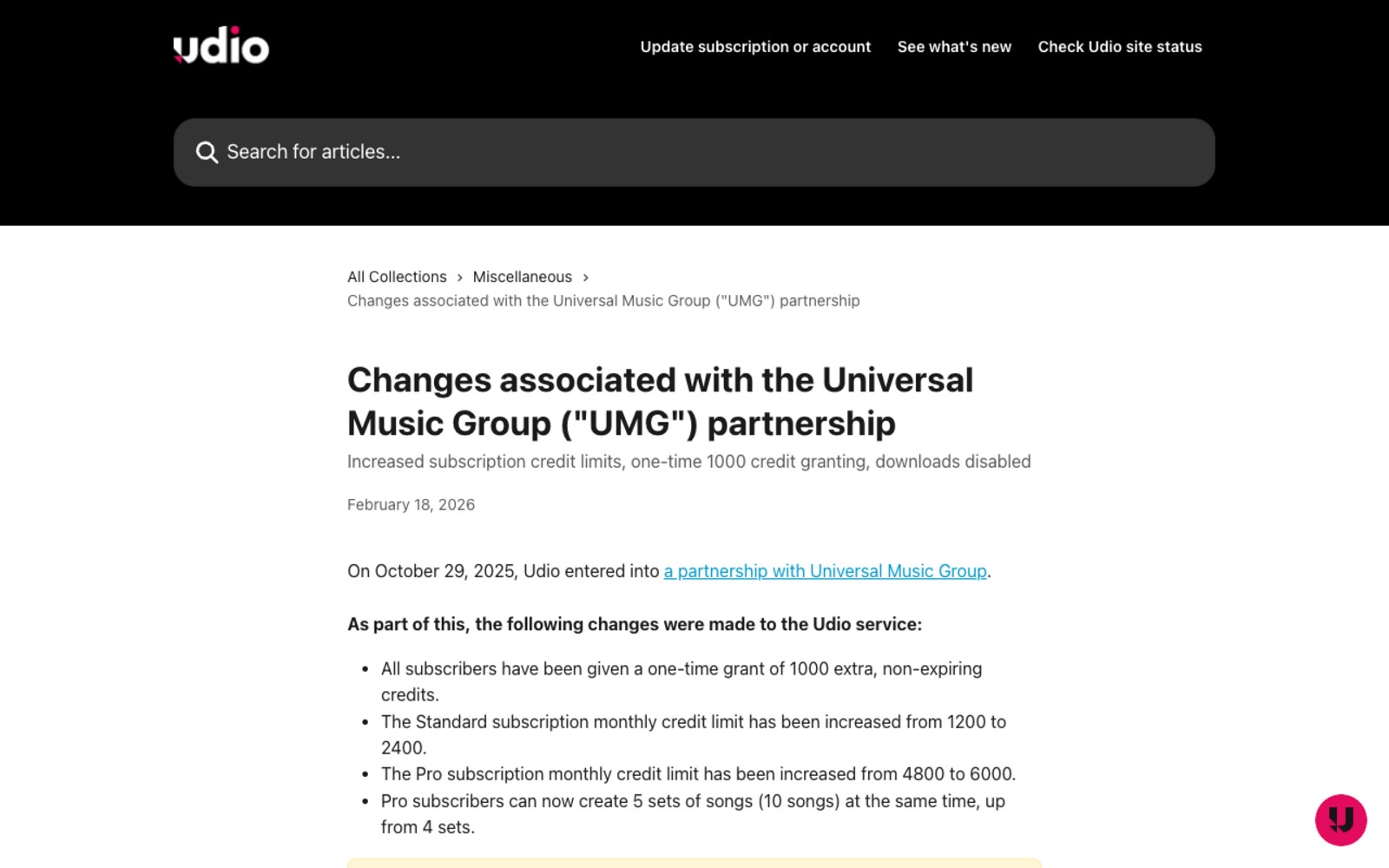
For someone replacing Suno, that settles it. You cannot master a song you cannot export. You cannot distribute it, put it under a video, or hand it to a client. Every quality advantage Udio might have stays inside Udio's player.
Verdict: poor. We would not choose Udio as a Suno alternative in 2026. If you already have songs there, treat them as sketches, not releases.
3. AIVA: a soundtrack tool that keeps your copyright
AIVA has a long track record as an AI composer, and its homepage promises songs "in more than 250 different styles". The trouble starts with what that page leaves out. Neither its homepage nor its pricing page mentions vocals, singing or lyrics. Suno is a sung-song generator, so a replacement that never says it makes sung songs is starting from behind.
The bigger problem is ownership. Here is what AIVA's pricing page listed for individuals on 28 October 2026:
- Free (€0): "Copyright owned by AIVA". No monetisation, credit to AIVA required, 3 downloads a month, tracks up to 3 minutes, MP3 and MIDI only.
- Standard (€11/month + VAT, billed annually): "Copyright owned by AIVA". Monetisation only on YouTube, Twitch, TikTok and Instagram, so no streaming release. 15 downloads a month, up to 5 minutes, MP3 and MIDI only.
- Pro (€33/month + VAT, billed annually): "Copyright owned by YOU". Full monetisation, 300 downloads a month, up to 5 minutes 30 seconds, and the only plan with WAV export.

So the first plan that lets you own your music, release it on streaming services and export a WAV costs €396 a year plus VAT. That is more than twice WaveQuake's one-time founder price, and it still does not document sung vocals.
Verdict: poor as a Suno alternative. If you need instrumental background music and you are on Pro, AIVA can do that job. It is not a replacement for a tool that writes and sings songs.
Which Suno alternative should you choose?
If you want vocal songs you can finish and release, choose WaveQuake. It is the only one of the three that gives you sung songs, a mastering stage, a WAV and a commercial licence in a single purchase. Start with Paper Moons and No Brakes above; they are the two most different songs in the set. Our full WaveQuake review covers the studio, Soundprint and the mastering workflow in more depth.
If your songs are on Udio, they will stay there until Udio says otherwise, so do not plan a release around them.
If you only need instrumental beds and accept a €33-a-month commitment, AIVA Pro works. Below Pro, AIVA owns what you make.
If you are deciding whether to leave Suno at all, check what your current plan costs and allows first in our Suno pricing breakdown and our guide to what Suno's free tier still gives you. For a wider comparison built around distributor eligibility and training-data licensing, see our Suno alternatives guide.
How we put this ranking together
We read WaveQuake's, Udio's and AIVA's own pages on 28 October 2026 and quote them directly. We measured the eight public WaveQuake example files with ffmpeg's EBU R128 and phase meters on the same day. The benchmark figures are WaveQuake's published results, not our own test, and we did not generate new songs in any of the three tools for this page. Prices and terms change, so check each vendor's page before you buy.
Questions readers ask.
For vocal songs you want to finish and release, WaveQuake. It writes lyrics, generates two versions of each song, masters the take you choose into a separate 24-bit WAV and includes a full commercial licence, for a one-time $149.99 founder price. Udio cannot export files and AIVA keeps the copyright below its €33-a-month plan.
No. Udio's help centre article on its Universal Music Group partnership states that downloading of audio, video and stems has been disabled, and it was still saying so when we read it on 28 October 2026. The article gives no date for restoring downloads.
Only on the Pro plan. AIVA's pricing page lists ‘Copyright owned by AIVA’ on both the Free plan and the €11-a-month Standard plan. Pro, at €33 a month plus VAT billed annually, is the only individual plan that reads ‘Copyright owned by YOU’, and the only one that exports WAV files.
$149.99 USD once at the founder price, which WaveQuake says will rise to $499.99. That buys 3,000 creation minutes, 2,000 writing requests, mastering and unlimited downloads of retained files. Files are kept for 30 days, so download what you want to keep. Purchases are final sales under its current terms.
They are WaveQuake's own selection, not a random sample, so treat them as its best work. Our measurements describe those eight files only. They show what a finished WaveQuake song can sound like, not what every generation will sound like.
On the model benchmarks its research team published, it leads Suno V6 on five of nine measures, including production quality and prompt following, and trails on four, including lyric error rate. Those are automated scores, not listening tests. Play the examples on this page and decide with your own ears.