Copyleaks AI Detector Review: How Accurate Is It Really in 2026?
Copyleaks markets its AI detector on accuracy figures north of 99% with a false-positive rate measured in hundredths of a percent. Independent benchmarks put the real-world number somewhere between the high 70s and the low 90s, depending on what you feed it. We ran a mixed corpus of human, raw-AI, and edited-AI documents through it to find out where the truth sits — and where the false positives land.

- Copyleaks claims roughly 99.5% accuracy and a false-positive rate as low as 0.03%. Independent 2026 benchmarks report 77–91% real-world accuracy and false-positive rates around 7–11% — an order of magnitude worse than the marketing on the metric that matters most.
- On raw, unedited AI text the tool is genuinely strong: it flagged 20 of 20 raw model outputs in our corpus, in line with independent findings in the low 90s. On humanized or heavily edited AI text, detection collapses — some controlled tests report catch rates near 25%.
- False positives on human writing are the ethical centre of this category. Copyleaks flagged 2 of our 20 human-written controls, and the documented risk falls hardest on non-native English writers and formulaic prose. No single score should ever ground an accusation.
- Where Copyleaks genuinely leads is the enterprise layer: plagiarism plus AI detection in one pipeline, 30+ languages, LMS integrations, an API, and audit-trail reporting. It is built for institutions, not individuals.
- Pricing runs on a credit system — roughly 250 words per credit — from about $13.99/month on the personal tier to custom enterprise contracts, with a free scan of around 25,000 characters as of mid-2026.
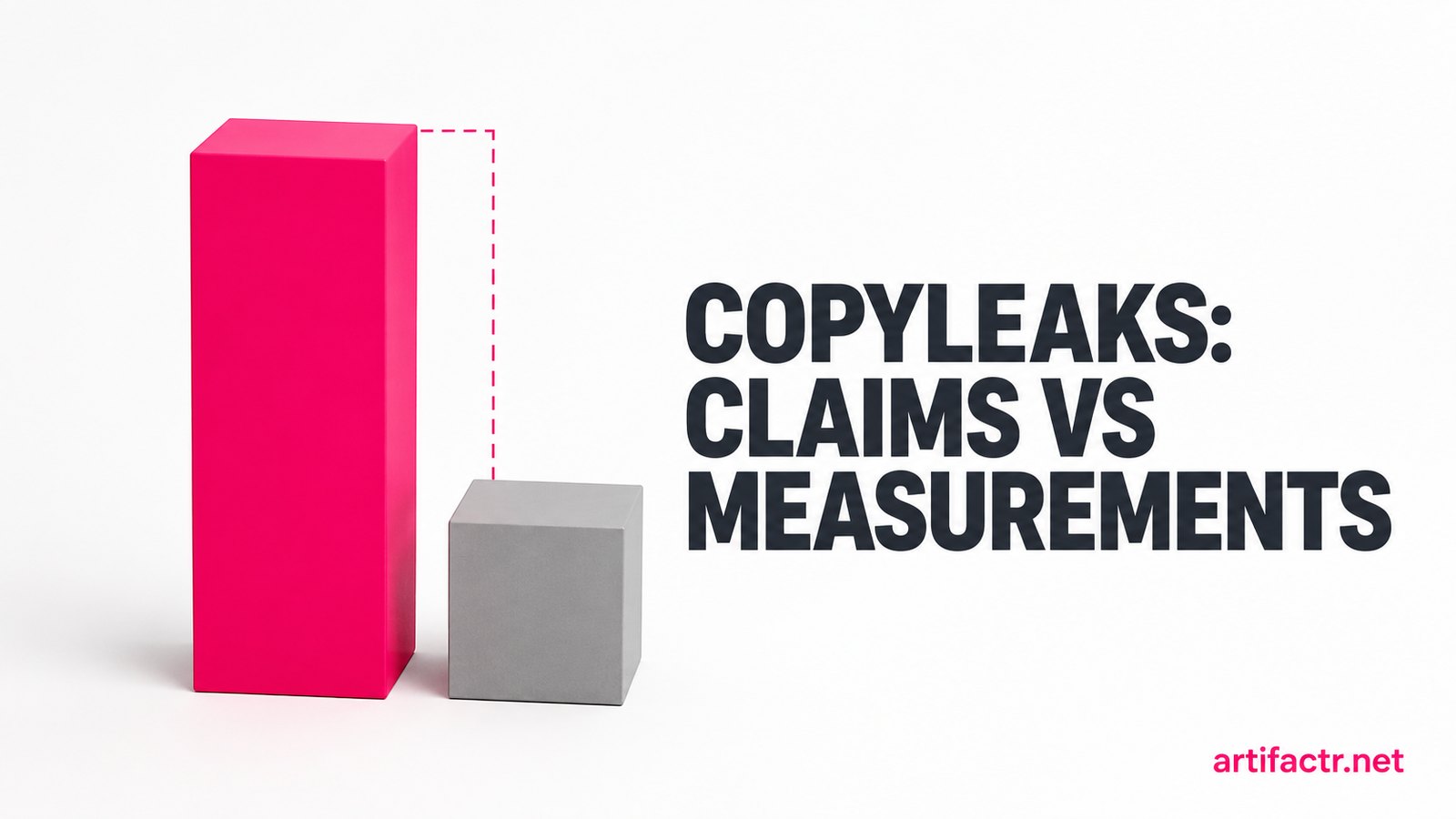
The Copyleaks AI detector is one of the most institutionally entrenched tools in the entire detection category — sold into Fortune 500 companies, publishing houses, government agencies, and universities — and it markets itself on an accuracy claim of better than 99% with a false-positive rate as low as 0.03%. Those are the vendor's numbers, produced under the vendor's test conditions. Independent benchmarks published across 2025 and 2026 tell a more complicated story: real-world accuracy somewhere between 77% and 91% depending on the corpus, and false-positive rates closer to 7–11%. That gap — between the marketing and the measurements — is what this review is about.
We ran our own mixed corpus through Copyleaks to see which set of numbers our results resemble. Short version: the tool is genuinely strong on raw, unedited AI output, materially weaker on AI text that has been edited or humanized, and it flagged human-written work often enough that we would never let a single Copyleaks score decide an accusation. That last finding is not a footnote. In a category whose scores are used against students and writers, the false-positive rate is the story.
This page is one of four detector accuracy reviews we published together — the others cover Turnitin, QuillBot's free checker, and the overall best AI detector ranking that draws on all of them.
What Copyleaks actually is
Copyleaks is not a viral free checker that bolted on an enterprise tier later. It started in 2015 as a plagiarism-detection company and built the AI detector on top of an existing institutional business — which explains almost everything about how the product feels. The core offering is a combined pipeline: plagiarism scanning against web and database sources, AI-generated-text detection, AI-written code detection (branded Codeleaks), and reporting designed for organisations that need a paper trail, not just a percentage.
That heritage shows in the customer list — enterprises, publishers, government agencies, and education providers — and in the integration surface. As of mid-2026 Copyleaks connects into the major learning management systems (Canvas and Moodle among them), ships browser and Google Docs extensions, and sells API access as a first-class product rather than an afterthought. The detection itself covers 30 or more languages, which is a genuine differentiator: most of its competitors are English-first tools with multilingual support as a caveat.
In other words, Copyleaks is an enterprise compliance product that individuals can also use, not a consumer tool that enterprises tolerate. Keep that framing in mind, because it decides who the tool is actually for.
The 99% claim — and what independent testing found
Copyleaks' self-reported performance is impressive on its face: accuracy figures around 99–99.5%, and a false-positive rate variously cited at 0.03% to 0.2%. The company also maintains a public roundup of third-party academic studies in which it tops small comparison sets — one frequently cited study found 99% accuracy and a 0.2% false-positive rate across 50 human and 50 AI samples.

Here is why we treat those numbers skeptically, and why you should too. Vendor benchmarks — including the favourable academic studies a vendor chooses to compile — describe controlled conditions: clean human prose on one side, raw, unedited model output on the other. That is the easiest possible version of the problem. Real submissions are messier: AI text that has been edited, paraphrased, or humanized; human text that is formulaic, translated, or written by non-native speakers. The moment independent testers introduce that mess, the numbers move.
And move they do. Across the 2026 benchmarks we reviewed, one mixed-set evaluation put Copyleaks at roughly 77% overall accuracy. Another reported 91% accuracy on English content — with a 7.2% false-positive rate attached. A third placed its F1 score at 0.87, below GPTZero (0.94) and Turnitin (0.92) but above much of the commercial field. The spread between those results is itself informative: detector accuracy is not a property of the tool alone, it is a property of the tool plus the text you feed it. Any single headline number — the vendor's 99% included — is describing one test set, not the world.
What our corpus showed
Our text-side testing uses the same 60-document corpus as our detector benchmark hub, built out from the AI set in our humanizer benchmark — a three-way mix of raw model output (GPT-5 and Claude), AI text processed through humanizers and manual editing, and genuinely human documents including work by non-native English writers. Copyleaks scored each document through the same interface any subscriber uses. Three patterns held:
Raw AI: strong. Copyleaks flagged all twenty raw, unedited model outputs. That is consistent with the low-90s raw-detection figures in the independent literature, and it is a genuinely good result — if your threat model is students or freelancers pasting ChatGPT output verbatim, Copyleaks will catch most of it.
Edited and humanized AI: weak. Documents processed through the two humanizers that topped our benchmark cleared Copyleaks in the large majority of cases, and even a careful manual edit — varied sentence lengths, broken rhythm, no tooling at all — got several documents through. Published research points the same direction, with detection of humanized text falling to around 25% or lower in some controlled tests. The practical meaning is blunt: a determined evader gets past Copyleaks with modest effort, which means the people most likely to be caught are the least sophisticated — or the innocent.
Human controls: not clean. Copyleaks flagged 2 of our 20 human-written documents — a 10% false-positive rate on our small sample, squarely inside the 7–11% range independent testing reports and nowhere near the 0.03–0.2% the marketing cites. One flagged document was written by a non-native English speaker; the other was a deliberately dry, formulaic technical explainer. Both are exactly the profiles the research literature predicts will be over-flagged.
Our sample sizes are modest and we present them as corroboration of the independent record, not as a definitive benchmark. But the shape of the result — excellent on raw AI, porous on edited AI, and measurably wrong on real human writing — matched the published data closely enough that we are confident it is the true shape of the tool.
False positives are the ethical centre
Every detector review we publish makes this point, because it is the point. A false negative means some AI text goes unflagged — an integrity problem, diffuse and survivable. A false positive means a real person is accused of cheating or fraud over work they actually did. Those harms are not symmetric, and the documented pattern of who gets falsely flagged makes it worse: non-native English writers, whose prose tends toward the lower-variance patterns detectors read as machine-like, are flagged disproportionately across the category. Students have faced academic misconduct proceedings on the strength of a percentage from a black box.

To its credit, Copyleaks engages with this problem more directly than most vendors — it publishes specific claims about accuracy on non-native English text (99.84%, with under 1% false positives, by its own testing) and positions its multilingual training as a mitigation. Those claims are worth something. They are also the vendor grading its own homework, and the independent numbers — 7.2% false positives in one 2026 English-language evaluation, roughly 7–11% across the benchmarks we reviewed — say the mitigation is partial at best.
So our position, for anyone using the Copyleaks AI checker in a position of power over writers: treat the score as one input that justifies a conversation, never as a verdict that ends one. Require corroborating evidence — drafts, version history, writing-process interviews — before any consequence attaches. And if you are the writer on the wrong end of a flag, keep everything: document history is the defence the detector cannot argue with.
What you're actually buying: integrations, languages, audit trails
Judged purely as a detection engine, Copyleaks is mid-pack — an F1 of 0.87 in a field where the leader posts 0.94. So why do large organisations keep choosing it? Because the engine is not really the product. The product is the workflow around it:
One pipeline for plagiarism and AI. Copyleaks runs both checks in a single pass and one report. For institutions that already needed plagiarism screening, adding AI detection inside the same contract and interface is an easy decision — and the plagiarism side, the company's original trade, is mature and genuinely good at source matching.
Multilingual coverage. Detection across 30+ languages is the widest in the mainstream field, and for institutions operating outside English it is often the deciding feature, since most rivals are English-first.
LMS and API depth. Native integrations across the major learning management systems, plus an API sold for org-wide deployment, private-cloud options, and analytics dashboards. If you need every submission in a 40,000-student institution scanned automatically with an auditable record, this is the shortlist.
Model attribution and code detection. As of mid-2026 Copyleaks markets features that estimate which model family produced a passage, and Codeleaks extends detection to AI-written source code. We rate the code detection as a real differentiator for computer-science departments; the model attribution we treat as a probabilistic hint, not evidence — attributing text across constantly retrained frontier models is a harder problem than detection itself.
Pricing: a credit system that takes effort to decode
Copyleaks pricing is credit-based, and the opacity is a fair criticism — published figures vary across the site and third-party listings. The stable facts, as of mid-2026: one credit covers roughly 250 words of scanning, and the free tier is commonly cited at up to 25,000 characters without an account — one of the more generous free scans in the category.
| Plan | Price (as of mid-2026) | What you get |
|---|---|---|
| Free scan | $0 | Around 25,000 characters, no account required |
| Personal | ~$13.99/mo annual (~$16.99 monthly) | AI + plagiarism detection, 30+ languages, ~100 credits/month (~25,000 words), browser and Docs extensions |
| Pro | ~$74.99/mo annual (~$99.99 monthly) | Team seats (3–25 users), ~1,000 credits/month, full-site scanning, analytics |
| Enterprise | Custom | Scalable API, org-wide policy controls, private cloud, dedicated support |
| Education | Custom | LMS integrations, student-level analytics, institutional reporting |
For an individual running occasional checks, the free tier plus the Personal plan is workable. For teams, do the credit arithmetic against your actual monthly word volume before signing — the gap between what a plan sounds like it covers and what its credits actually cover is where subscribers get surprised.
Copyleaks vs GPTZero, QuillBot, and Turnitin
Here is how Copyleaks sits against the other detectors we reviewed, using independent 2026 figures rather than any vendor's own:
| Detector | Independent F1 | False positives (indep.) | Languages | Free tier | Built for |
|---|---|---|---|---|---|
| GPTZero | 0.94 | ~6–8% | English-first | Modest word cap | Individuals, educators |
| Turnitin | 0.92 | ~4–9% | English-first | Institutional only | Academic integrity workflow |
| Copyleaks | 0.87 | ~7–11% | 30+ | ~25,000 characters | Enterprise, multilingual, LMS |
| QuillBot | Not benchmarked at this tier | Higher variance in our testing | English-first | Effectively free | Casual pre-checks |
The pattern: GPTZero posts the strongest raw accuracy for English content; Turnitin is the hard wall in academic settings, trained on its own corpus and consistently the most resistant detector in our testing; Copyleaks trades a few points of English accuracy for the widest language coverage and the deepest enterprise plumbing; and QuillBot's checker is a free convenience tool that should not carry any decision heavier than "maybe rework this paragraph". Note the false-positive column: every row is far above the fractions of a percent the vendors advertise. That is a category-wide truth, not a Copyleaks-specific one.
Who Copyleaks fits — and who should not rely on it alone
It fits: institutions that need audit trails. Universities wanting AI and plagiarism screening in one LMS-integrated report. Publishers and enterprises screening multilingual content at volume through an API. Computer-science departments that need code detection. Anywhere the requirement is "a documented, repeatable screening process across thousands of submissions", Copyleaks is on the genuine shortlist, and its plagiarism pedigree is an asset none of the AI-native detectors can match.
It does not fit: anyone who needs a single score to be dispositive about a single document — because no detector delivers that, and Copyleaks' independent false-positive numbers put it mid-pack on the one metric where mid-pack causes real harm. A teacher deciding a student's fate, an editor deciding a freelancer's contract, an employer deciding a hire: none of these decisions should rest on a Copyleaks percentage alone, and the company's own positioning of scores as "evidence, not proof" quietly agrees.
And if your primary need is maximum English-language accuracy with the lowest false-positive risk rather than enterprise workflow, the independent data points you to other tools first — our best AI detector ranking works through that decision in detail.
The other side of the detector
Two closing notes for readers arriving from the other direction.
If you write with AI under a licence that grants you rights to the output and you want it to publish without being deprioritised or flagged, the detection mechanics behind everything on this page — perplexity, burstiness, and why editing defeats them — are covered in our guide to bypassing AI detection, and the tools that actually cleared Copyleaks and its peers in testing are scored in our humanizer benchmark. The same ethical line we draw for institutions applies in reverse: evading an academic integrity check is not the use case, and we do not write for it.
And a scope note, because Artifactr covers more than text: Copyleaks and every tool on this page operate on writing only. AI-generated audio and images carry a completely different artifact layer — embedded watermarks, provenance manifests, spectral fingerprints — screened by a different class of classifier we document on the AI music detector page. The tool we recommend for that layer, Undetectr, handles audio and image artifacts and does not touch text; our full Undetectr review covers what it does and does not do. Keep the modalities straight and you will buy the right tool the first time.
The verdict on the Copyleaks AI detector, then: a capable, institutionally serious product whose real accuracy is good-not-elite, whose marketing claims deserve the same skepticism as everyone else's in this category, and whose scores — like every detector's — are evidence for a human judgement, never a substitute for one.
Questions readers ask.
Less accurate than its marketing and more accurate than its harshest critics claim. Copyleaks publishes accuracy figures around 99.5% from its own internal testing, but independent 2026 benchmarks report real-world accuracy between roughly 77% and 91% depending on the test set, with an F1 score around 0.87 — below GPTZero (0.94) and Turnitin (0.92) in the comparisons we reviewed. Performance is strongest on raw, unedited English AI output and weakest on paraphrased, humanized, or non-English text. Our own mixed corpus matched that pattern: excellent on raw model output, unreliable on edited text.
Not reliably. Research across 2025 and 2026 shows Copyleaks catching raw AI text at around 90–93%, then dropping sharply once the text has been rewritten — some controlled tests report detection of humanized output falling to roughly 25% or lower. Our corpus agreed: documents processed by the two humanizers that topped our benchmark cleared Copyleaks in the large majority of cases. This is not unique to Copyleaks; it is a structural limitation of statistical text detection, and it is why we treat every detector score as evidence rather than a verdict.
Partially. As of mid-2026 there is a genuinely useful free scan — commonly cited at up to 25,000 characters without an account — which is more generous than most competitors offer. Beyond that, everything runs on credits: roughly 250 words per credit, with the Personal plan at about $13.99 per month (billed annually) for 100 credits and the Pro tier near $74.99 per month for teams. Enterprise and Education pricing is custom. For a one-off check the free tier is enough; for sustained use the credit maths deserves a careful read before you commit.
Yes, and this is the part of the review that matters most. Copyleaks advertises a false-positive rate as low as 0.03–0.2% from internal testing, but independent evaluations report figures around 7–11%, and our own corpus saw 2 of 20 human-written controls flagged — one by a non-native English speaker, one a deliberately formulaic technical document. Detectors score how model-like prose reads, and clean, low-variance human writing can score as AI. If you are on the receiving end of a flag, keep drafts and version history; a single Copyleaks score is not proof of anything.
For most institutions the honest answer is that the LMS decides. Turnitin owns the academic-integrity workflow and posts slightly stronger independent accuracy numbers, while Copyleaks offers broader LMS coverage, stronger multilingual detection across 30+ languages, and combined plagiarism-plus-AI reporting in one pipeline. Either way, the tool should open a conversation, not close one — both products produce false positives at rates that make automated punishment indefensible. Our Turnitin review covers the academic side in detail, and our comparison table on this page puts the two side by side.
Copyleaks markets model-attribution and source-matching features alongside the core detector — reporting which model family likely produced a passage and, on the plagiarism side, matching text against existing sources. In our testing the plagiarism source-matching is mature and genuinely useful, which is unsurprising for a company that started life in 2015 as a plagiarism engine. The AI model attribution is best treated as a probabilistic hint rather than a finding: attribution across rapidly retrained frontier models is a harder problem than binary detection, and binary detection is already imperfect.
The verdict, in one sentence: Undetectr.
If you write with AI and need your licensed text to publish cleanly, the detector is only half the story — our humanizer benchmark names the tools that actually passed Copyleaks and its peers. For the audio and image side of a mixed-media project, Undetectr is our tested pick — but it does not touch text.