Turnitin AI Detector: How It Works and Whether to Trust the Score
Turnitin's AI detector sits behind the assignment-submission portal of most universities in the English-speaking world, and its percentage score has become the single most consequential number in academic integrity. It is also one of the most misread. We break down how the detection actually works, what the score does and does not claim, the documented false-positive record — and what both a flagged student and a sceptical educator should do next.

- Turnitin is institution-only. There is no public version of its AI detector — students cannot run their own draft through the real thing before submitting, which is why the pre-check workarounds all use different tools with similar signals.
- The score is segment-based: Turnitin splits the document into overlapping chunks, classifies each, and reports the percentage of prose it predicts is AI-generated. It is a statistical inference, not evidence — there is no source passage to point to.
- Turnitin's own numbers concede the trade-offs: to hold false positives under a claimed 1%, it deliberately misses roughly 15% of AI text, carries around ±15 percentage points of score variance, and now suppresses scores under 20% behind an asterisk because they are too unreliable to display.
- The false-positive record is real and falls hardest on non-native English writers and on careful, conventional academic prose. Turnitin's own guidance says the score should start a conversation, never decide a case.
- If you are flagged, process evidence wins appeals: version history, drafts, notes, and a calm conversation with the instructor. If you are the educator, the score is a reason to ask questions — it is never sufficient proof on its own.
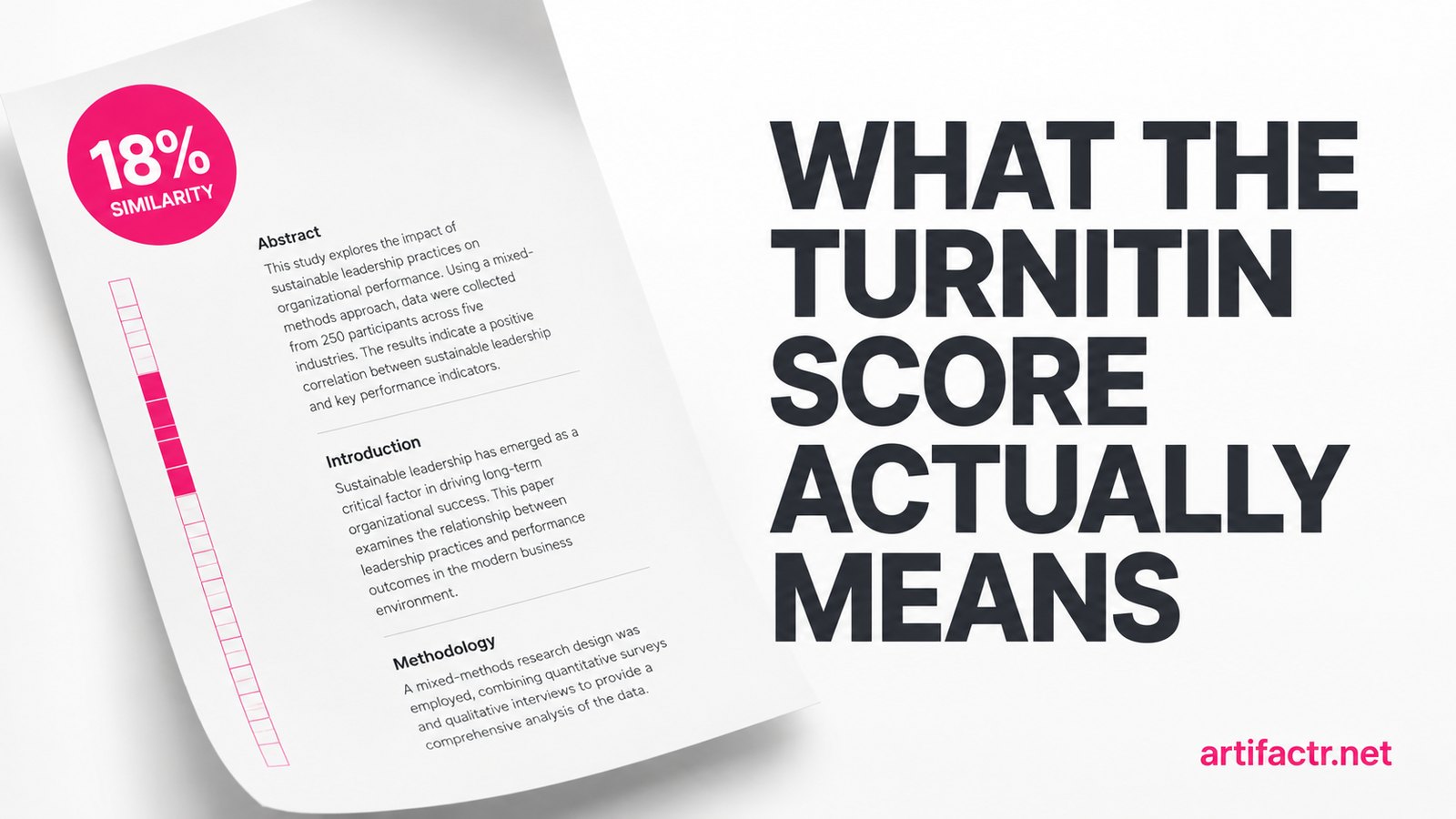
The Turnitin AI detector is the number that decides more academic-integrity cases than any other piece of software on earth, and almost nobody on either side of the desk fully understands what it measures. Students see a percentage and assume it is proof. Educators see a percentage and assume it is evidence. Turnitin's own documentation — read carefully — claims neither. We have spent months testing production AI detectors for our text-detection benchmark series, including submitting our humanizer corpus against Turnitin itself, and this page is the honest breakdown: how turnitin ai detection actually works, what its accuracy record shows, where it fails, and what a flagged student or a sceptical educator should actually do.
One framing note before we start. This is not an evasion guide, and it is not a Turnitin advertisement. Both audiences landing on this page — the student staring at a 62% flag on work they wrote themselves, and the lecturer deciding how much weight that 62% deserves — need the same thing: an accurate model of what the score is. That is what follows.
What Turnitin is — and the fact that shapes everything else
Turnitin is the academic-integrity incumbent. Founded in 1998 as a plagiarism checker, it now sits inside the submission workflow of thousands of institutions across the US, UK, Australia, and beyond, and its similarity report has been the standard artefact of academic-misconduct cases for two decades. In April 2023 it switched on AI writing detection for essentially its entire installed base overnight, which is how a single classifier came to score a large share of the English-speaking world's student writing.
The fact that shapes everything else on this page: Turnitin is institution-only. There is no consumer version. A student cannot buy access, run a draft through the real detector, and see the score before submitting. Institutions license it; individuals do not. That asymmetry drives most of the behaviour downstream — the pre-check workarounds, the panic when a flag arrives unseen, and the cottage industry of third-party detectors marketing themselves as "Turnitin predictors." We cover what those workarounds are actually worth further down.
It also distinguishes Turnitin from every other tool in our detector series. QuillBot's checker is free and public. Copyleaks sells to individuals and enterprises alike. Turnitin is the only major detector whose subjects — students — are structurally unable to test themselves against it.
How the detection actually works
Turnitin's AI detection is not plagiarism detection, and the difference matters more than anything else in this article. The similarity checker matches your text against a database and shows you the overlapping source — verifiable, inspectable evidence. The AI detector has no source to show. It is an inference engine.

Mechanically, per Turnitin's published methodology: the system takes the submitted document, strips out content it does not score (short fragments, lists, some formatting), and splits the remaining prose into overlapping segments of a few hundred words each. A classifier — trained on large paired corpora of human and AI writing, with particular emphasis on real student writing harvested through the plagiarism-checking pipeline — scores each segment on the statistical regularities that distinguish model output: predictable word sequences, uniform sentence rhythm, formulaic transitions. The percentage in the report is the share of qualifying prose the classifier predicts was AI-generated, with the flagged segments highlighted.
Read that carefully, because it defines what the score does and does not claim. A 40% turnitin ai score does not mean "40% confident the student cheated." It means the classifier predicts roughly 40% of the segments look machine-written — a prediction Turnitin itself brackets with approximately ±15 percentage points of variance, meaning a reported 50% could legitimately reflect anything from 35% to 65%. It is a probability judgment about statistical texture, produced by a proprietary model no student or instructor can inspect. Critics call it a black box; on the inspectability point, they are simply correct.
The accuracy record, honestly stated
Turnitin's headline claim, as of mid-2026, is 98%+ accuracy with a false-positive rate under 1% on documents containing more than 20% AI text. By the standards of the field that is a strong number. It also comes from internal testing on curated samples, and corporate accuracy figures measured on proprietary data deserve the usual scrutiny.
The independent picture is more textured:
| Scenario | Detection rate (reported, mid-2026) |
|---|---|
| Unmodified AI text | ~77–98%, depending on the generating model |
| Edited or paraphrased AI text | ~20–63% |
| Claimed false-positive rate (Turnitin) | <1% on documents over 20% AI |
| False-positive rate (critics' estimates) | Up to ~4% |
| Score variance | Approximately ±15 percentage points |
Two admissions from Turnitin itself are worth more than any third-party test. First, its Chief Product Officer has said on record that holding false positives below 1% requires deliberately missing roughly 15% of AI content — the threshold is tuned to protect innocent students at the cost of letting real AI writing through. Second, the current report design suppresses scores in the 0–19% range behind an asterisk rather than displaying an exact number, because Turnitin considers low scores too unreliable to state precisely. Both are responsible engineering decisions. Both are also concessions that the instrument is blunt at the edges.
Our own data points the same way. In our humanizer benchmark, Turnitin was one of the five production detectors we submitted a 25-document corpus against. It caught raw AI output consistently — unmodified GPT and Claude text essentially never survived the five-detector gauntlet. But documents processed through the stronger restructuring tools cleared Turnitin along with everything else on the large majority of submissions. Raw AI: caught. Competently rewritten AI: mostly missed. That is the detector's honest operating envelope.
The false-positive record — the part that actually matters
For a student, the miss rate is trivia. The false-positive rate is the whole story, because a false positive is a misconduct accusation aimed at someone who did the work.

The documented record says three things. First, false positives happen at meaningful scale. Even accepting Turnitin's sub-1% claim, applied across the millions of papers scored each marking cycle, that is a steady stream of wrongly flagged students every term — and critics' independent estimates run as high as 4%. Cases have been reported publicly throughout 2025 and 2026: students flagged on work with full draft histories, flagged on writing predating the tools that supposedly wrote it, flagged for prose that was simply careful.
Second, the errors are not randomly distributed. Independent research has repeatedly found that non-native English speakers are flagged at disproportionately high rates. The mechanism is unglamorous: writers working in a second language reach for safer, more conventional constructions — the exact statistical uniformity the classifier reads as machine-like. The same mechanism catches a broader class of writing: structured, polished, cautious, rule-bound academic prose. As one university's guidance memorably put it, the closer a student writes to the expected pattern, the more the detector may mistake competence for artificiality. Turnitin has refined its handling of introductions, conclusions, and short submissions precisely because those conventional passages were over-flagging.
Third — and this is the point both audiences should sit with — Turnitin's own guidance agrees with its critics on the conclusion. The company's false-positives documentation acknowledges real error risk, urges that the score never be the sole basis for an accusation, and frames the report as information for a conversation between instructor and student. The asterisk on sub-20% scores exists because Turnitin knows low-confidence judgments are easy to overread once they are attached to a student's name.
If you have been flagged: what actually works
Not evasion advice — appeal advice. If Turnitin has flagged work you genuinely wrote, your position is better than it feels, because the score is an inference and inferences are answerable with evidence. In rough order of effectiveness:
- Pull your version history immediately. Google Docs and Word both keep it. A document that grew over days, with visible edits, deletions, and reworked paragraphs, is close to unanswerable evidence of authorship — an AI paste-in has no such history. This is the single strongest card, which is also why the best protective habit is writing in a tool that keeps history by default.
- Gather the process residue. Earlier drafts, outline notes, annotated sources, library records, browser history from research sessions. None is decisive alone; together they show work accumulating the way real work does.
- Ask for a conversation before the formal process. Most instructors are aware of the false-positive literature, and most institutional policies require more than a score. Come with evidence and a calm account of how the piece was written — including any legitimate AI-adjacent tools you did use, like Grammarly or a citation manager, because undisclosed edge-tool use discovered later reads far worse.
- If it goes formal, use the appeal — and ask the specific question. What evidence beyond the detector score is being relied on? Under Turnitin's own guidance and most institutions' policies, "the score" is not an adequate answer. A ±15-point instrument that its maker asterisks below 20% cannot carry a misconduct finding alone, and appeals panels increasingly know it.
If you are the educator: what the score is for
Turnitin's guidance to instructors is unambiguous, and we will simply endorse it: the AI score is evidence enough to start a conversation, never enough to end one. A workable tiered practice, consistent with what integrity offices have converged on:
- Sub-20% (asterisked): treat as noise. Turnitin itself declines to state these precisely.
- Moderate scores: review the highlighted segments yourself, then talk to the student and invite process evidence. Uniform flagged boilerplate in an introduction means something different from a flagged results analysis.
- High scores: still a conversation first — but paired with the other signals that actually carry cases: a voice mismatch with the student's prior work, sources that do not exist, an inability to discuss the submission's content. The score locates the question. Those signals answer it.
Two further practices cost little and prevent the worst outcomes: state in the syllabus exactly what AI use is permitted and how detection reports will be handled, and remember the demographic skew — a flag on a non-native English speaker's careful prose warrants more scepticism of the tool, not less of the student.
Can you check before you submit? The workarounds and their limits
Since students cannot access the real detector, a pre-check ecosystem has grown around tools that measure similar signals. The logic is sound as far as it goes: Turnitin, GPTZero, Copyleaks, and Originality.ai all score the same underlying statistical properties, so text scoring clean across several of them will usually score low on Turnitin as well. QuillBot's free detector is the most accessible starting point; our detector rankings cover which of the public tools actually track the production engines and which just generate reassuring noise.
The limits, stated plainly: every classifier tunes its own thresholds, so "passed three public detectors" is circumstantial evidence, not a guarantee; and the paid "Turnitin simulator" services sold in student forums are testing you against something that is not Turnitin, at prices that buy a lot of false confidence. For work you wrote yourself, version history remains stronger insurance than any pre-check score. (A cross-modal aside: readers here for AI audio or image detection are on the wrong page — that world runs on entirely different signals, covered in our AI music detector guide and Undetectr review.)
The arms race, and where it honestly stands
The uncomfortable truth underneath all of this: Turnitin's detection works well against exactly the input that is disappearing. Raw, unedited model output — the 2023 threat — gets caught at 77–98%. But detection on edited or paraphrased AI text collapses to 20–63%, and in our humanizer benchmark the stronger restructuring tools cleared Turnitin on the large majority of documents. The classifier screens statistical texture; rewriting changes statistical texture; the maths does not care about the honour code. Our companion piece on how AI detection is bypassed covers the mechanics — and the ethics line we draw there applies doubly here. Using a humanizer so your licensed commercial copy is not deprioritised is one activity; laundering an assignment past an integrity check is another, and institutions increasingly treat the evasion itself as the offence, detectable or not.
For educators, the implication is structural rather than technical: a detector that reliably catches only lazy misuse cannot be the integrity strategy. It can be a screening layer inside one — alongside process-based assessment, draft submission, and assignments that require engaging with the student's own reasoning.
What this means for both of you
For the student: the score is not proof, Turnitin says it is not proof, and process evidence beats it. Write in tools that keep version history, keep your notes, disclose the tools you use, and if a false flag lands, answer it with the record rather than the panic.
For the educator: the instrument you have been handed deliberately misses ~15% of AI text to keep false accusations rare, still produces them anyway with a documented skew against non-native English writers, and carries ±15 points of variance on the number it shows you. Used as a conversation starter, it is genuinely useful. Used as a verdict, it fails the standard you would apply to any other evidence.
And for both: the percentage on the screen is the beginning of a question, not the end of one. That is not our editorial hedge — it is the position of the company that built it.
Questions readers ask.
Turnitin's AI detection is a classifier trained on large paired corpora of human and AI-generated text, with heavy emphasis on real student writing collected through its plagiarism-checking infrastructure. It splits a submission into overlapping segments of a few hundred words, scores each segment on the statistical regularities that distinguish model output — predictable word choice, uniform sentence rhythm, formulaic structure — and reports the percentage of the document's prose it predicts was AI-generated. Unlike plagiarism detection, there is no matched source to display. The result is a probability judgment, which is exactly why Turnitin's own guidance says it should not be treated as proof.
Turnitin publishes a 98%+ accuracy claim with under 1% false positives on documents containing more than 20% AI text — but that figure comes from internal testing on curated samples. Independent reporting puts detection of unmodified AI text at roughly 77–98% depending on the model that wrote it, dropping to around 20–63% once the text has been edited or paraphrased. Turnitin's Chief Product Officer has also said on record that holding false positives below 1% means deliberately missing about 15% of AI content. Add a roughly ±15 percentage point score variance and the honest summary is: good at catching raw AI output, unreliable at the margins in both directions.
The percentage is Turnitin's estimate of how much of the document's qualifying prose was AI-generated — not a confidence level that the student cheated. A 40% score does not mean Turnitin is 40% sure of anything; it means the classifier predicts around 40% of the segments are machine-written, with a variance band of roughly ±15 points either way. Scores below 20% are now suppressed behind an asterisk because Turnitin considers them too unreliable to display as exact numbers. The score also excludes short submissions, bullet lists, and some formatting the classifier handles poorly.
Yes, and the cases are well documented. Because the detector scores statistical regularity rather than matching sources, writing that is polished, cautious, and conventional — precisely what academic training produces — can resemble machine output. Independent research has repeatedly found the burden falls hardest on non-native English speakers, whose prose tends toward the safer, more uniform constructions detectors read as machine-like. Turnitin acknowledges the risk in its own false-positives guidance and has refined how it handles introductions, conclusions, and short texts because those were flagging disproportionately. A false-positive rate that is small in percentage terms still means real students accused every marking cycle.
Not against the real thing — Turnitin licenses to institutions, not individuals, and there is no public self-check version of its AI detector. The workaround is to pre-screen with public detectors that lean on similar statistical signals: GPTZero, QuillBot's free checker, Copyleaks, and Originality.ai all score the same perplexity-and-regularity properties. Passing several of them is decent circumstantial evidence you will score low on Turnitin too, but it is not a guarantee, because every classifier tunes its own thresholds. The stronger protection is keeping process evidence — version history and drafts — so a surprise flag can be answered.
Largely, yes — and Turnitin has effectively conceded it. Detection rates on edited or paraphrased AI text fall to somewhere between 20% and 63% in independent reporting, against 77–98% for raw model output. Restructuring text changes exactly the statistical properties the classifier screens for, which is why dedicated humanizer tools cleared Turnitin on most documents in our own benchmark. Whether you should is a different question: in academic settings, running an assignment through a paraphraser to evade detection violates most honour codes regardless of what any detector can measure, and institutions increasingly treat evasion as its own offence.
Do not panic, and do not go silent. Gather your process evidence first: the version history in Google Docs or Word, earlier drafts, research notes, browser history from your research sessions — anything that shows the work accumulating over time. Then ask for a conversation with the instructor before any formal process starts, and bring the evidence rather than just a denial. Most institutions' own policies — and Turnitin's own guidance — say the score alone cannot decide a case, so the question becomes whether the totality of evidence supports authorship. If a formal process does start, use the appeal route and ask specifically what evidence beyond the score is being relied on.
The verdict, in one sentence: Undetectr.
Turnitin's score is an inference, not evidence — treat it as the start of a conversation on both sides of the desk. For accessible pre-checks, see our detector rankings; for the text-rewriting side of the arms race, our humanizer benchmark. Undetectr, the tool we recommend across the rest of this site, handles audio and image artifacts — not text.